


A 17th Century William and Mary eight-day table clock by Johnathan Lowndes, 1695
£21,500
Follow Us
A 17th Century William and Mary eight-day table clock by Johnathan Lowndes, 1695
A very attractive William and Mary eight-day spring-driven table clock, signed on the backplate Jonathan Lowndes, Pall Mall, À Londres, circa 1690–95.
The well-proportioned ebony-veneered oak domed top case has rectangular viewing windows to the sides, allowing the movement to be almost entirely visible. The dome is surmounted by a pierced gilt brass ornament, whilst at the top of the door there is a pierced gilt brass strip functioning as a sound fret. The case rests on four gilt brass bun feet.
The fine square brass dial has a matted centre with ringed winding holes. There is a date aperture above the VI and a strike/silent lever above the XII (N/S), flanked by the maker’s name, Jonathan Lowndes. This is echoed by the engraving at the bottom of the dial: Londres. The dial has an applied silvered chapter ring and winged cherub-head spandrels to the corners. The chapter ring is engraved with a narrow outer minute ring; within are Arabic five-minute numerals, a central ring with Roman hour numerals I–XII and very pronounced half-hour markers, and an inner ring divided into quarter hours. The time is indicated by a fine pair of pierced, period blued steel hands.
The striking eight-day twin-fusee, five-pillar brass movement has a verge escapement with a short knife-suspended pendulum. The striking, regulated by an internal rack, sounds the hours in full on a bell. The backplate is profusely engraved in an unusual period style, centred around an uncommon signature cartouche bearing the maker’s name, Jonathan Lowndes à Londres. The movement also features pull-quarter repeat, sounding the quarters on one bell and the hours on the other.
The maker
Jonathan Lowndes was born around 1656 in Knutsford, Cheshire, and became a free brother of the Worshipful Company of Clockmakers in 1680. While much is known about his career, the identity of his master remains unknown. He took several apprentices and was active until at least 1702, possibly as late as 1710.
Note: The fact that the clock is signed à Londres probably indicates that Lowndes, like other makers such as Massey, sought to extend his market to the Continent. This is supported by the layout of the chapter ring, notably the elaborate half-hour markers.
Condition
Good. Wear consistent with age and use.
Dimensions
13.78 in (35 cm)
Width: 9.45 in (24 cm)
Depth: 6.5 in (16.5 cm)
Literature
B. Loomes, The Clockmakers of Great Britain 1286–1700, Ashbourne, 2014, p. 328
PREVIOUSLY SOLD

18th Century Japanned Chinoiserie Dome-Topped Box, Circa 1715-1725
18th Century Japanned Chinoiserie Dome-Topped Box, Circa 1715-1725 SoldFollow Us18th Century Japanned Chinoiserie Dome-Topped Box, Circa 1715-1725 Early 18th century George I Japanned Chinoiserie dome-topped box, Circa 1715-1725. England or...
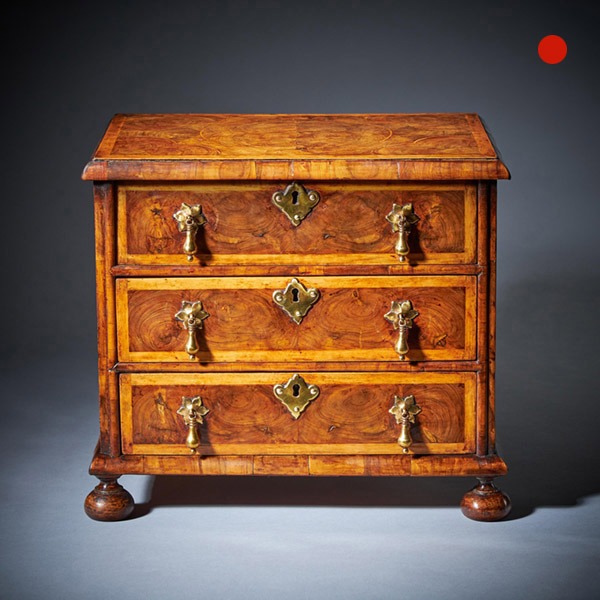
Miniature William and Mary 17th Century Diminutive Olive Oyster Chest C.1690
Miniature William and Mary 17th Century Diminutive Olive Oyster Chest, C.1690 SOLDFollow UsMiniature William and Mary 17th Century Diminutive Olive Oyster Chest, C.1690 A Fine Miniature William and Mary 17th Century Diminutive Olive Oyster...
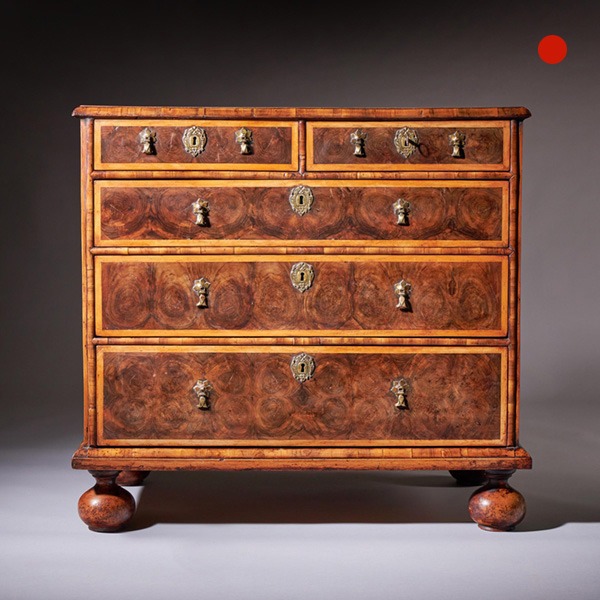
17th Century William and Mary Olive Oyster Chest of drawers, Circa 1690. England
17th Century William and Mary Olive Oyster Chest of drawers SoldFollow Us17th Century William and...

Pair of 18th Century George III Silver Candlesticks by David Bell, London, 1762
Pair of 18th Century George III Silver Candlesticks by David Bell, London, 1762 Sold[wpforms_selector form_id="11387" show_title="on" _builder_version="4.22.1" _module_preset="default" custom_margin="-30px||||false|false"...

Robert Adam George III Silver Gilt Vase by Daniel Smith and Robert Sharp London
Robert Adam George III Silver Gilt Vase by Daniel Smith and Robert Sharp London Sold[wpforms_selector form_id="11387" show_title="on" _builder_version="4.22.1" _module_preset="default" custom_margin="-30px||||false|false"...

Rare 18th Century George III Lacquer Tea Caddy with Original Lacquer Canisters
Rare 18th Century George III Lacquer Tea Caddy with Original Lacquer Canisters SoldFollow UsRare...
18th Century Japanned Chinoiserie Dome-Topped Box, Circa 1715-1725
18th Century Japanned Chinoiserie Dome-Topped Box, Circa 1715-1725 SoldFollow Us18th Century Japanned Chinoiserie Dome-Topped Box, Circa 1715-1725 Early 18th century George I Japanned Chinoiserie dome-topped box, Circa 1715-1725. England or...
Miniature William and Mary 17th Century Diminutive Olive Oyster Chest C.1690
Miniature William and Mary 17th Century Diminutive Olive Oyster Chest, C.1690 SOLDFollow UsMiniature William and Mary 17th Century Diminutive Olive Oyster Chest, C.1690 A Fine Miniature William and Mary 17th Century Diminutive Olive Oyster...
17th Century William and Mary Olive Oyster Chest of drawers, Circa 1690. England
17th Century William and Mary Olive Oyster Chest of drawers SoldFollow Us17th Century William and...
Pair of 18th Century George III Silver Candlesticks by David Bell, London, 1762
Pair of 18th Century George III Silver Candlesticks by David Bell, London, 1762 Sold[wpforms_selector form_id="11387" show_title="on" _builder_version="4.22.1" _module_preset="default" custom_margin="-30px||||false|false"...
Robert Adam George III Silver Gilt Vase by Daniel Smith and Robert Sharp London
Robert Adam George III Silver Gilt Vase by Daniel Smith and Robert Sharp London Sold[wpforms_selector form_id="11387" show_title="on" _builder_version="4.22.1" _module_preset="default" custom_margin="-30px||||false|false"...
Rare 18th Century George III Lacquer Tea Caddy with Original Lacquer Canisters
Rare 18th Century George III Lacquer Tea Caddy with Original Lacquer Canisters SoldFollow UsRare...
YOU MAY ALSO LIKE

An early 18th century Queen Anne japanned chinoiserie cabinet on stand
An early 18th century Queen Anne japanned chinoiserie cabinet on stand £24,000Follow UsAn early...

A Fine William and Mary Figured Walnut Cabinet on a Gilt-Gesso Stand Circa 1700
A Fine William and Mary Figured Walnut Cabinet on a Gilt-Gesso Stand, Circa 1700 £18,000Follow UsA...

Important William and Mary Olive Oyster and Floral Marquetry Cabinet on Stand
Important William and Mary Olive Oyster and Floral Marquetry Cabinet on Stand £65,000Follow...

A fine 18th Century George II burr walnut kneehole desk, circa 1730 England
A fine 18th-century George II burr walnut kneehole desk, circa 1730 England £24,000Follow UsA fine...

A Fine Pair of George III Blue John and Gilt Bronze Cassolettes circa 1780
A Fine Pair of George III Blue John and Gilt Bronze Cassolettes, circa 1780. £18,500Follow UsA...
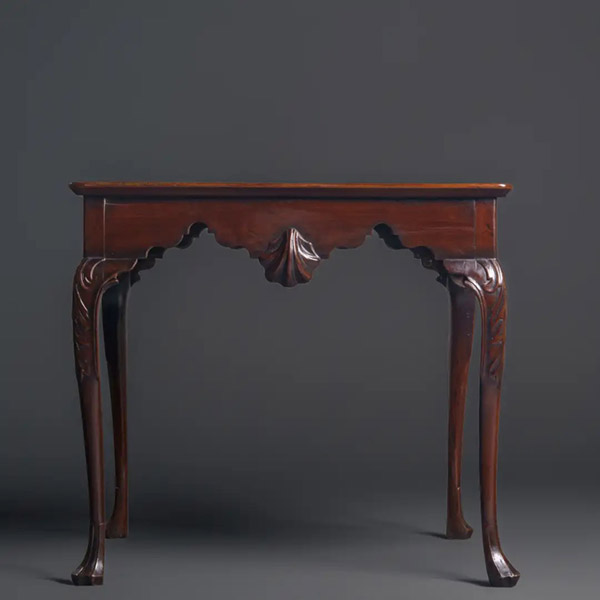
A Fine Irish George II Carved Mahogany Side/Silver Table, circa 1740
A Fine Irish George II Carved Mahogany Side/Silver Table, circa 1740 £6,500Follow UsA Fine Irish...
An early 18th century Queen Anne japanned chinoiserie cabinet on stand
An early 18th century Queen Anne japanned chinoiserie cabinet on stand £24,000Follow UsAn early...
A Fine William and Mary Figured Walnut Cabinet on a Gilt-Gesso Stand Circa 1700
A Fine William and Mary Figured Walnut Cabinet on a Gilt-Gesso Stand, Circa 1700 £18,000Follow UsA...
Important William and Mary Olive Oyster and Floral Marquetry Cabinet on Stand
Important William and Mary Olive Oyster and Floral Marquetry Cabinet on Stand £65,000Follow...
A fine 18th Century George II burr walnut kneehole desk, circa 1730 England
A fine 18th-century George II burr walnut kneehole desk, circa 1730 England £24,000Follow UsA fine...
A Fine Pair of George III Blue John and Gilt Bronze Cassolettes circa 1780
A Fine Pair of George III Blue John and Gilt Bronze Cassolettes, circa 1780. £18,500Follow UsA...
A Fine Irish George II Carved Mahogany Side/Silver Table, circa 1740
A Fine Irish George II Carved Mahogany Side/Silver Table, circa 1740 £6,500Follow UsA Fine Irish...